AI Is Making Coding Cheap. So What Actually Matters for Software Engineers?
When implementation becomes easier, the durable advantage shifts toward problem selection, product judgment, engineering fundamentals and the ability to ship responsibly.
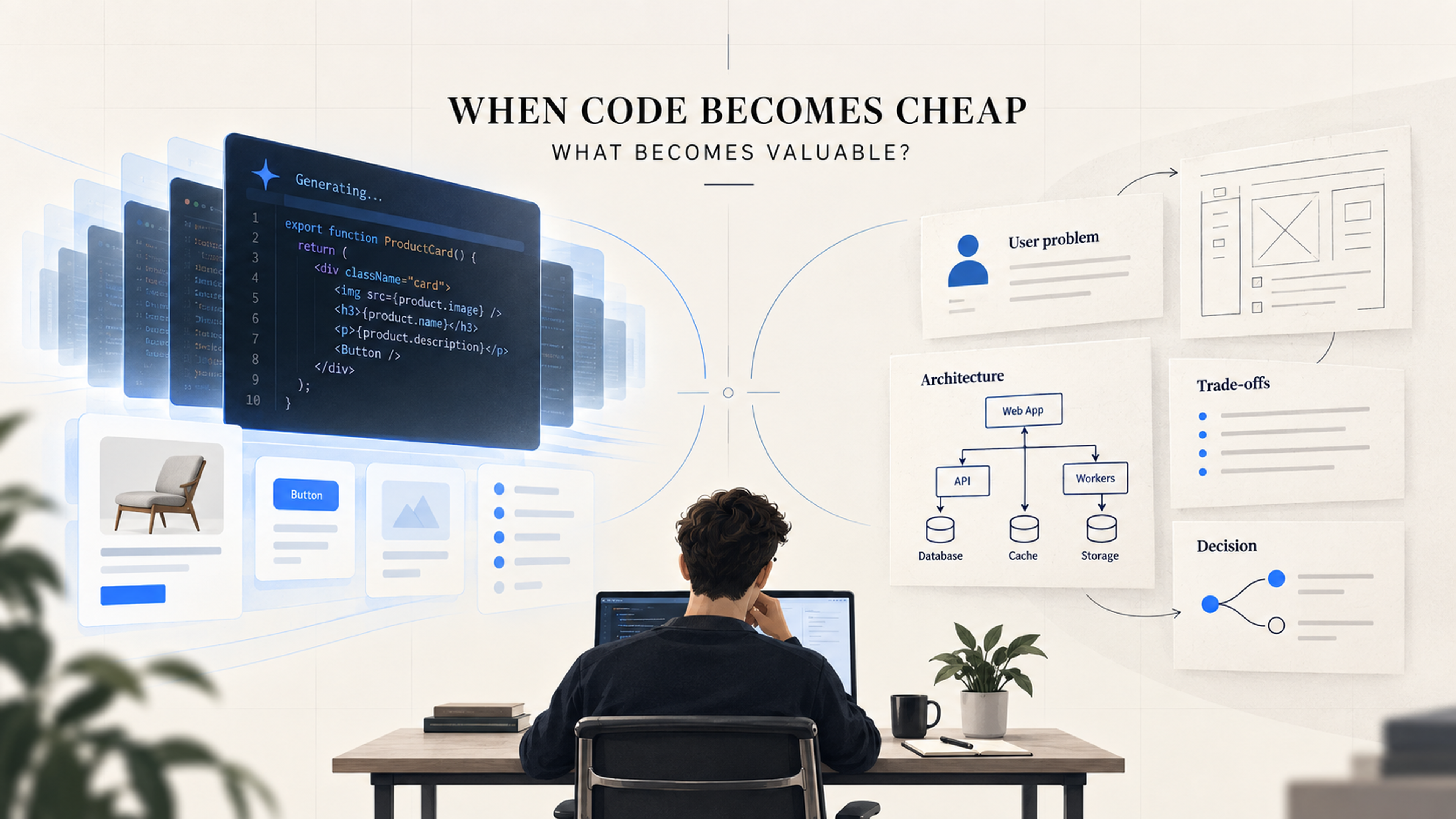
A strange thing is happening in software development.
Writing code is getting easier.
Not just a little easier. In some cases, dramatically easier.
You can describe a feature, ask an AI coding tool to build it, review what it generates, make a few changes, and have something working surprisingly quickly. Things that used to require hours of boilerplate can sometimes be reduced to a conversation.
For developers, that's exciting.
But it also raises a question that I don't think we talk about enough:
If writing code keeps getting cheaper, what becomes valuable for a software engineer?
I don't think the answer is simply "learn AI."
There will always be another model, another framework, another coding agent and another tool promising to make development faster.
The more interesting shift is happening somewhere else.
When implementation becomes easier, deciding what to build, understanding why it should exist, and making sure it continues to work become more important.
And that changes what being a good software engineer actually means.
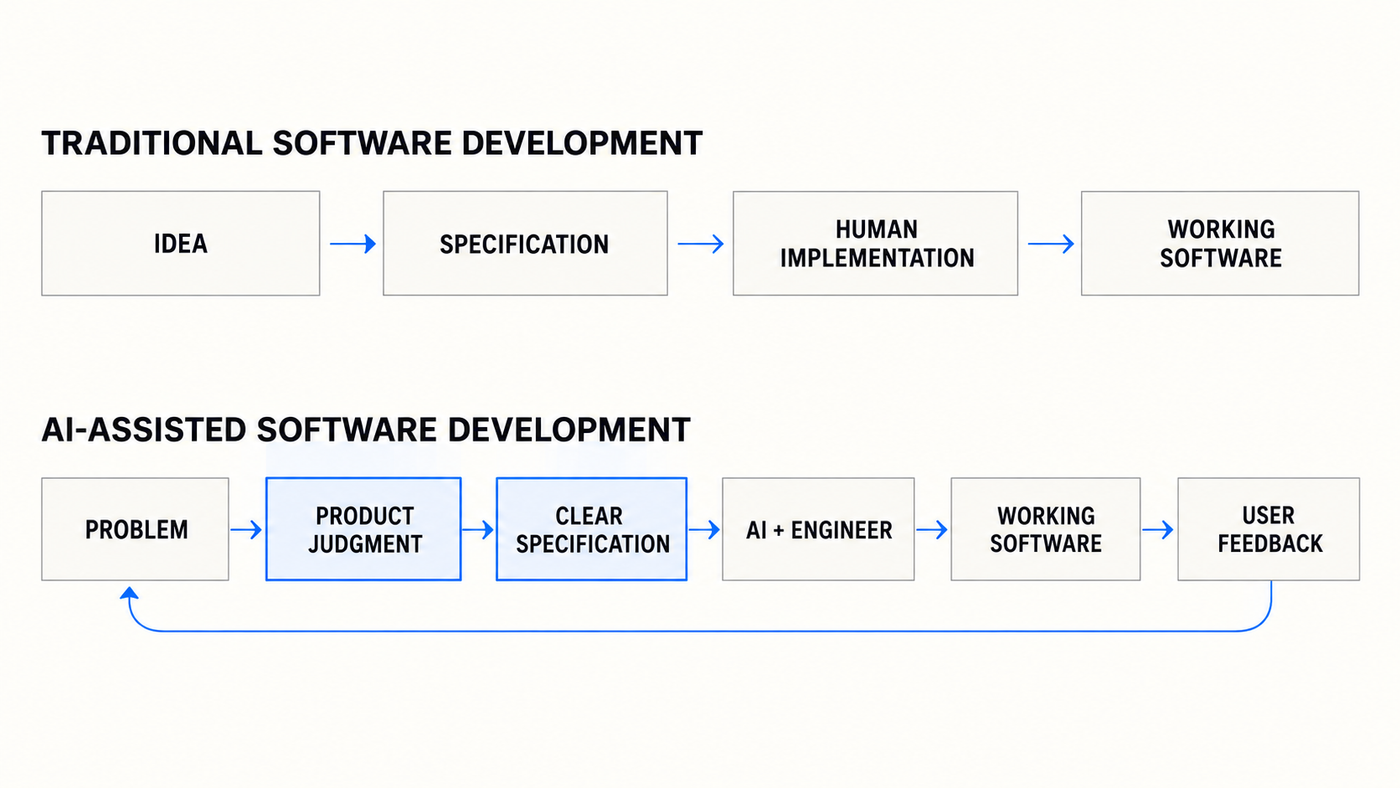
The hardest part may no longer be writing the code
For a long time, software development had a fairly obvious bottleneck.
Someone had an idea. The team discussed it. A specification was written. Then developers had to turn that specification into working software.
That implementation step could take a significant amount of time.
AI is changing that equation.
Today, an engineer can use AI to generate components, write API endpoints, create database queries, explain unfamiliar code, produce tests and help investigate bugs. The exact capabilities will keep changing, but the direction is pretty clear: the distance between an idea and a working prototype is getting shorter.
That sounds like the entire software development process should become easier.
But there's a catch.
AI can help answer:
"How do we build this?"
It doesn't automatically answer:
"Should we build this?"
That's a different problem.
Maybe the feature nobody is using shouldn't have been built in the first place.
Maybe the customer doesn't actually have the problem the team assumed they had.
Maybe there are three ways to solve the problem and the simplest one is better than the most impressive one.
Those decisions require context.
They require talking to users, understanding constraints and making trade-offs.
And this is where I think the role of the engineer starts to expand.
The rise of the product-minded engineer
The traditional boundary between product and engineering has always been somewhat artificial.
Product teams understand the user problem.
Engineers understand how to build the solution.
But when AI makes implementation faster, that separation can become less useful.
Imagine an engineer who receives a feature request and immediately starts coding.
Now imagine another engineer who first asks:
- Who is this feature actually for?
- What problem are they experiencing?
- How frequently does it happen?
- What is the simplest way to solve it?
- How will we know whether the solution worked?
- What happens if the feature fails?
The second engineer may spend more time thinking before writing code.
But once the direction is clear, they can use AI to move extremely quickly.
That's the interesting combination.
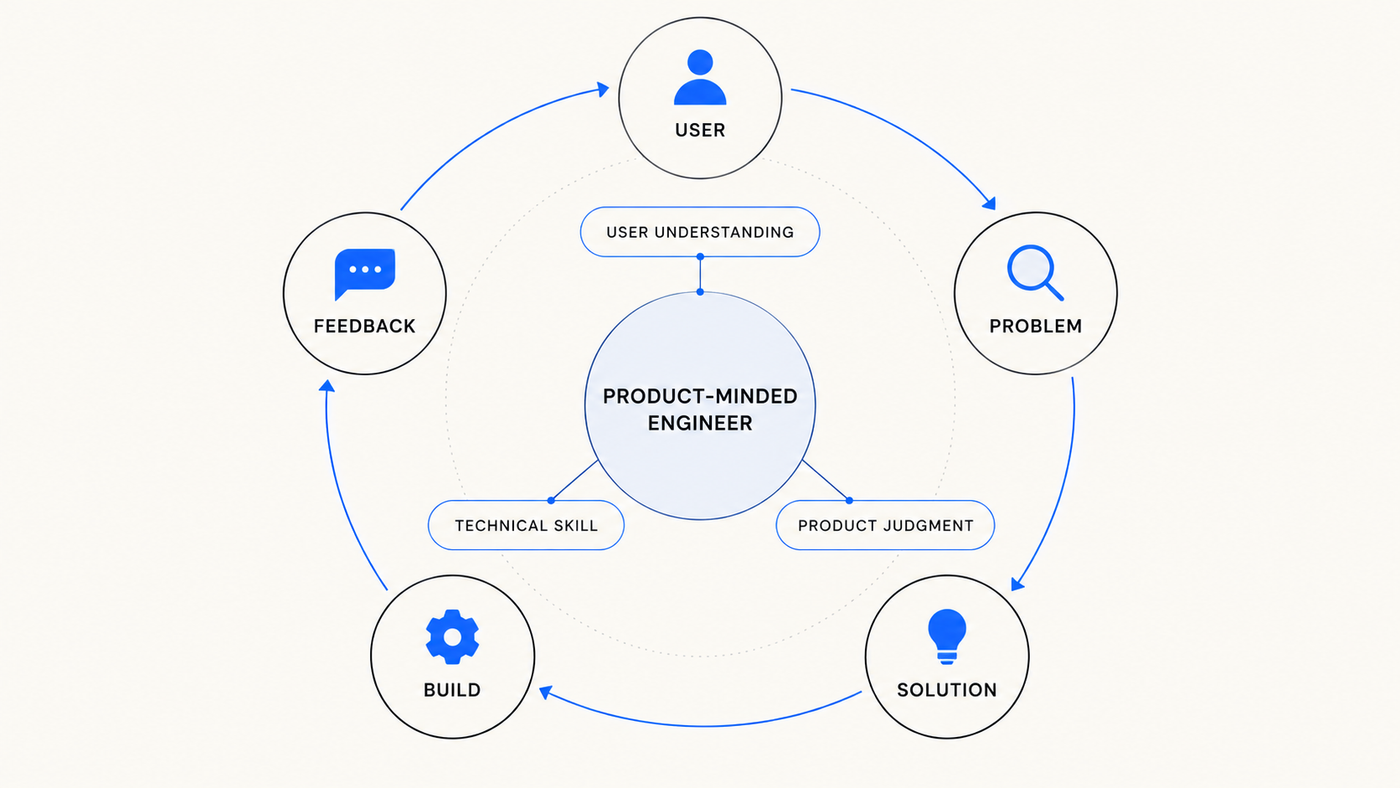
Product understanding + engineering ability + AI leverage.
Instead of simply being the person who implements tickets, an engineer can become someone who helps shape the solution itself.
And when coding becomes faster, that kind of judgment becomes more valuable.
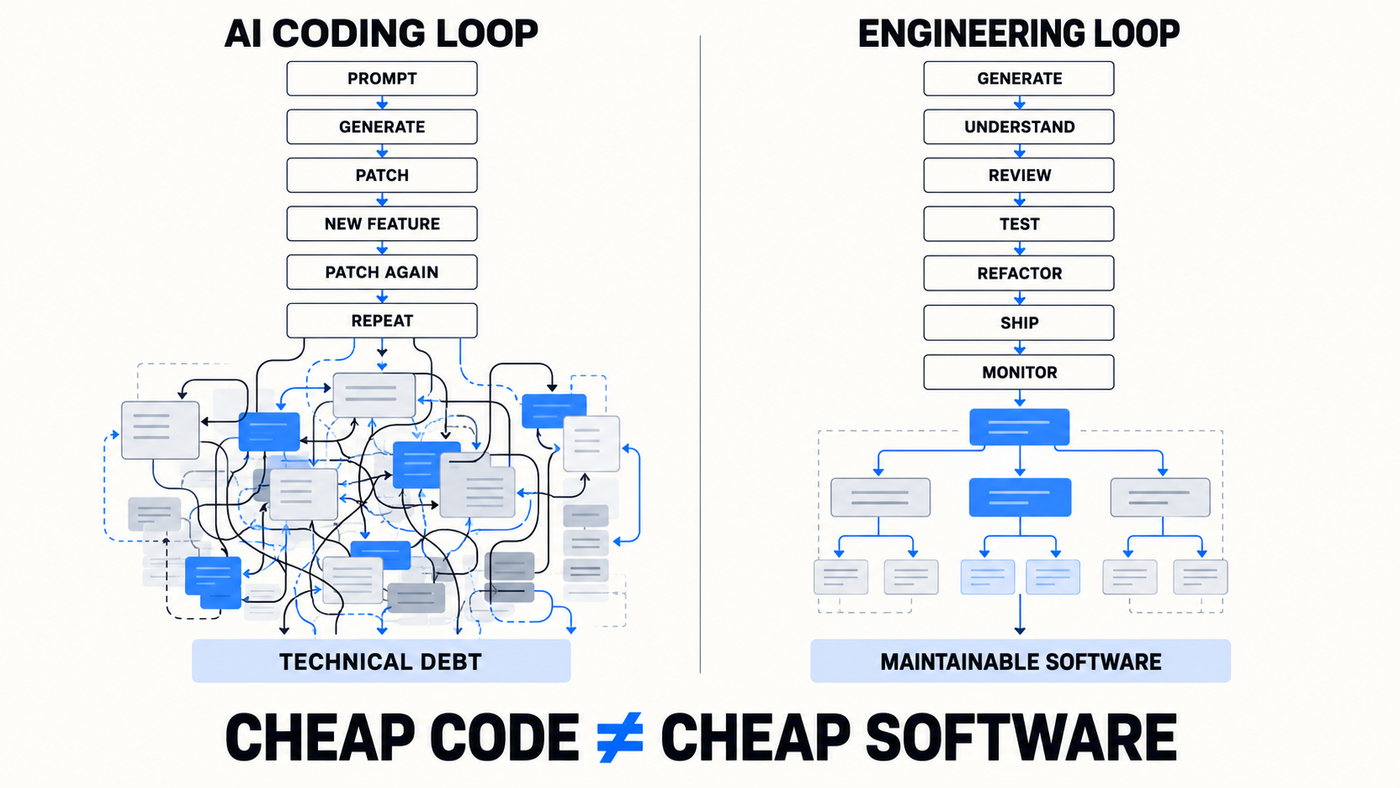
AI-generated code creates another problem: technical debt
There's another side to all this speed.
AI makes it incredibly easy to keep adding things.
Need a new feature?
Generate it.
Something broke?
Ask AI to fix it.
The fix created another issue?
Ask AI to fix that too.
Before you know it, the application has grown considerably.
And everything appears to work.
Until it doesn't.
The problem isn't that AI-generated code is automatically bad. It isn't.
The problem is that you can generate code much faster than you can develop a deep understanding of a growing system.
That's where technical debt becomes important.
You might have duplicated logic in five places.
You might have unnecessary abstractions.
You might have error handling that only works for the happy path.
You might have database queries that work with 100 records but become painful with a million.
You might have code nobody on the team is comfortable changing because nobody really understands why it was written that way.
AI can help create all of these things if developers stop thinking and start accepting every generated solution at face value.
That's why I like a simple distinction:
Cheap code is not the same as cheap software.
Generating a function might take seconds.
Maintaining a system for five years is a completely different problem.
"It works" isn't the finish line
This is probably one of the biggest mindset changes developers need to make.
When using AI coding tools, it's tempting to judge the output with one question:
"Does it work?"
That's necessary.
But it's not enough.
A better set of questions might be:
Does it work?
Do I understand why it works?
What happens when it fails?
Is it secure?
Will another developer understand it?
Can we change it six months from now?
Does the architecture make sense?
Those questions are what turn generated code into engineered software.
And this is where I don't think strong engineering fundamentals become less important.
They may become more important.
If an AI generates ten possible implementations, someone still needs to recognize the difference between a clean solution and a future headache.
The developer advantage is moving from typing to judgment
There's an easy assumption that AI coding tools will make programming skills less valuable.
I'm not convinced that's the right way to look at it.
Think about calculators.
Calculators made arithmetic faster. They didn't make mathematics disappear.
The same kind of distinction applies here.
If you understand databases, you can better judge the database code an AI generates.
If you understand networking, you can recognize when a generated architecture has a networking problem.
If you understand security, you can spot an insecure implementation.
If you understand system design, you can question whether the proposed architecture will actually survive growth.
The tool gives you speed.
Your knowledge gives that speed direction.
That's why blindly relying on AI can actually put inexperienced developers in a strange position. They can produce more code than before without necessarily understanding more software than before.
The output looks impressive.
The understanding may not be there.
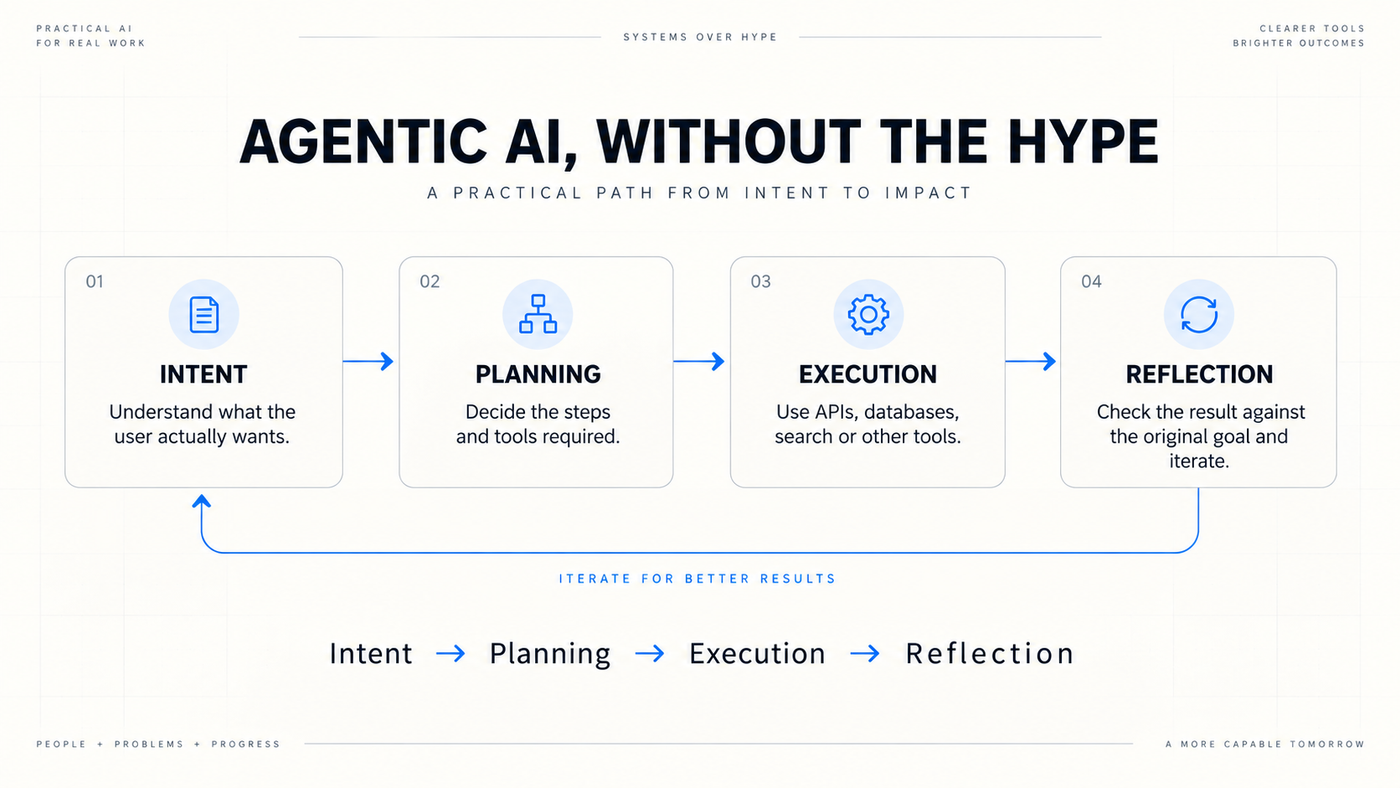
AI agents sound complicated, but the basic idea isn't
Another term that has taken over the AI conversation is "agents."
Sometimes the word makes the technology sound more mysterious than it really is.
At a practical level, an agentic system can be thought of as a loop.
First, it needs to understand the user's intent.
Then it needs to plan what should happen.
After that, it executes the plan using tools such as APIs, databases, search or other software.
Finally, it should reflect on the result and check whether it actually accomplished the original goal.
That's a useful way to think about agents because it removes some of the magic.
The difficult part isn't necessarily getting a demo to work.
The difficult part is making the system reliable.
What if the API is unavailable?
What if the agent chooses the wrong tool?
What if the data is incomplete?
What if the result looks convincing but is wrong?
What if the user asks for something ambiguous?
Again, we're back to engineering.
The AI might be doing more of the work, but somebody still has to design the system around it.
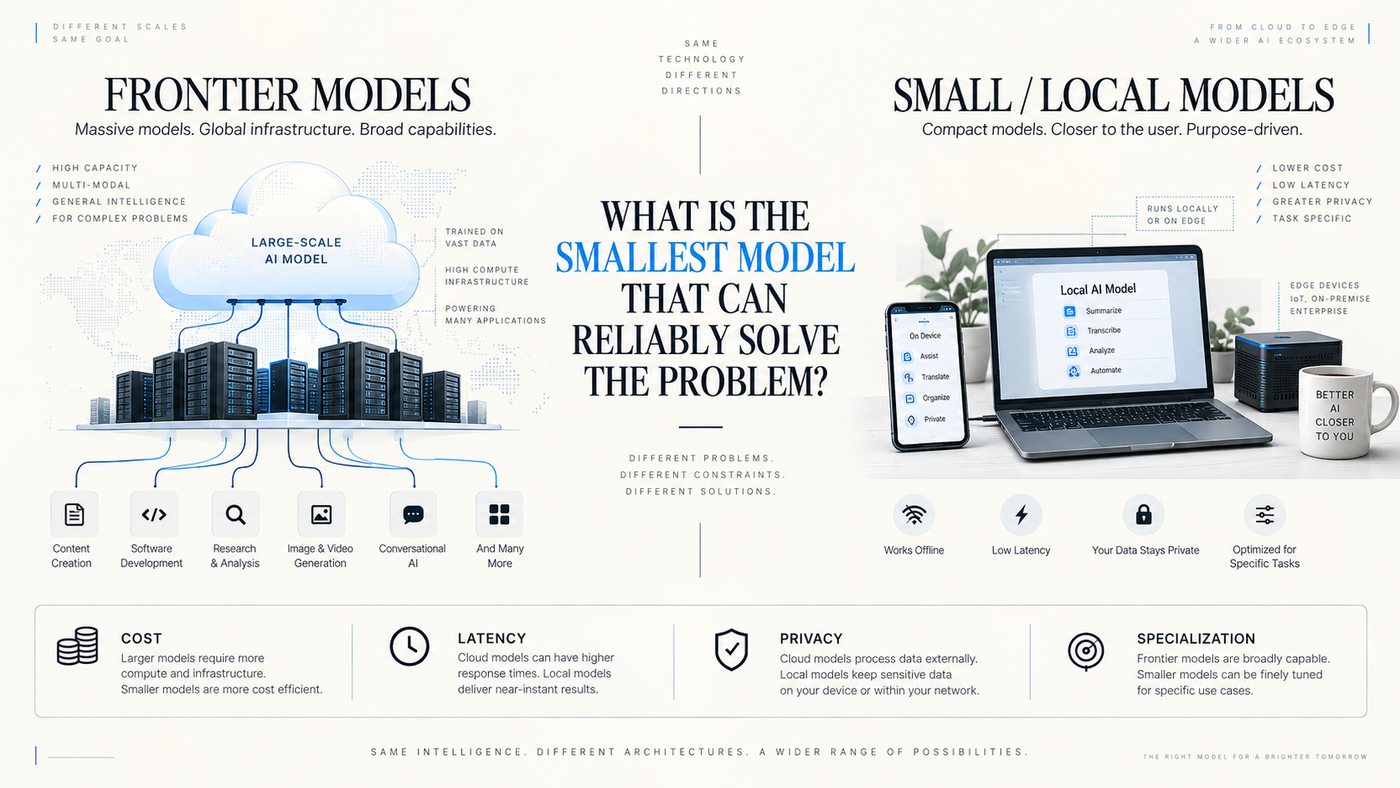
Bigger AI models won''t automatically be the answer to everything
There's also an interesting direction developing alongside the race toward increasingly powerful frontier models.
Smaller models.
Models that can be specialized for particular tasks.
Models that can potentially run locally or closer to the user.
For some applications, using the biggest model available makes sense.
For others, it might be unnecessary.
If you're building a system where privacy matters, sending sensitive information to an external service may not always be desirable.
If you're processing millions of simple requests, model cost matters.
If latency is critical, running something closer to the user can make a difference.
If the task is narrow and well-defined, a smaller specialized model may be enough.
That creates another engineering question:
What is the smallest and simplest AI system that can reliably solve this problem?
That's a much more useful question than simply asking which model has the largest benchmark score.
The future of AI engineering probably won't be one-size-fits-all.
We'll have large frontier models, smaller specialized models, local models, cloud models and combinations of all of them.
Choosing between them will itself become an engineering decision.
The AI job market is rewarding something different
There's also a reality that developers can't ignore.
The industry has moved beyond the stage where simply attaching "AI" to a project automatically makes it interesting.
A prototype can be impressive.
But companies eventually care about what happens after the demo.
Does it save time?
Does it reduce costs?
Does it improve a workflow?
Does it increase revenue?
Does it solve a real customer problem?
Does it work reliably in production?
That's why I think there's a growing gap between AI experimentation and AI engineering.
Experimentation is valuable. It's how we discover what works.
But eventually someone has to turn the experiment into a dependable product.
And that's where engineering discipline comes back into the picture.
Maybe the best developers will be the ones who can move between worlds
The developers I find most interesting aren't necessarily the ones who know the most tools.
They're the ones who can move between different ways of thinking.
They can talk to a user and understand the problem.
They can think about the business impact.
They can design a technical solution.
They can use AI to accelerate implementation.
They can review what AI generated.
They can recognize when a shortcut is reasonable and when it's going to become technical debt.
And they can actually ship.
That's a pretty powerful combination.
It also means that learning shouldn't become a race to collect technologies.
You don't need to know every new framework that appears every few weeks.
You need to understand the foundations well enough that new tools become things you can evaluate rather than things you have to blindly follow.
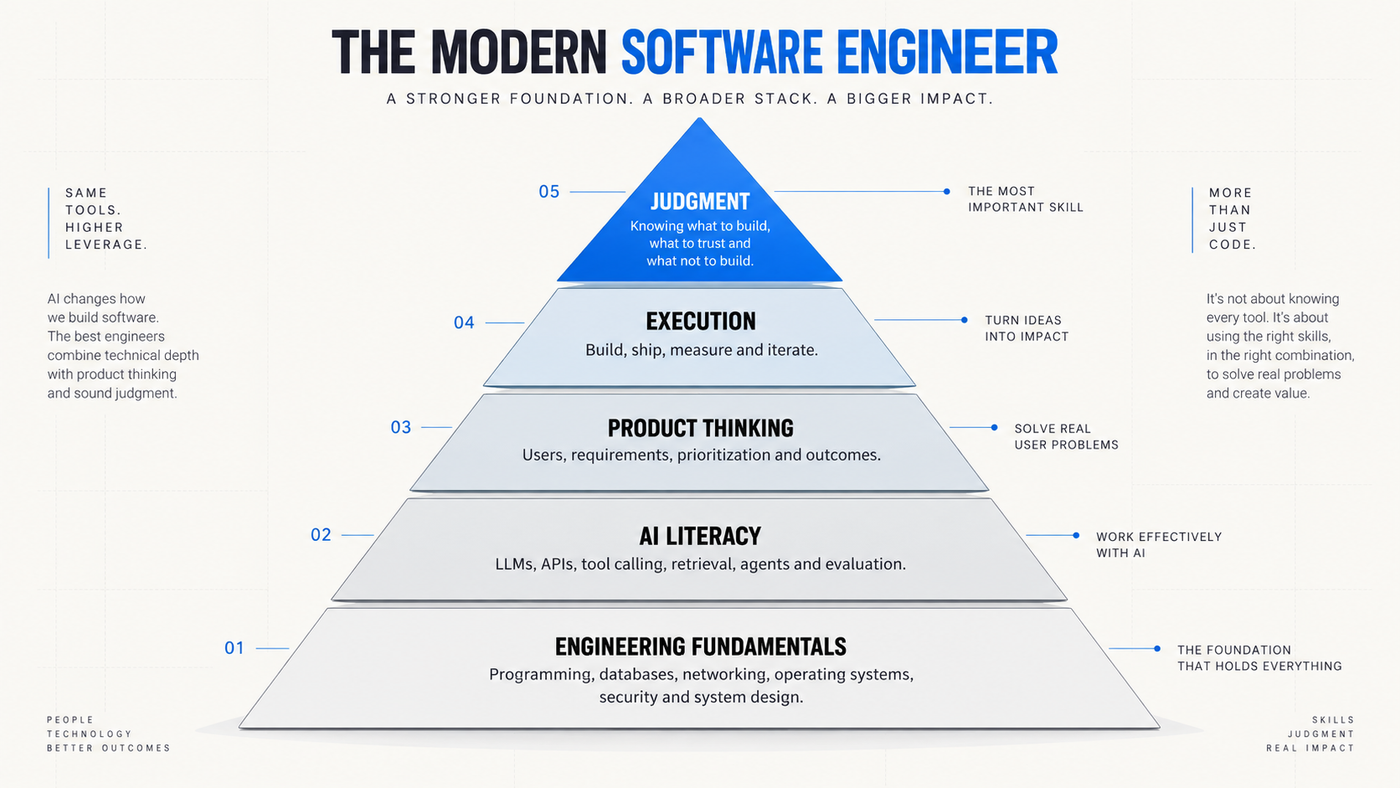
So what should software engineers learn now?
If you're a developer trying to figure out where to invest your time, I wouldn't throw away the fundamentals because AI can write code.
I'd go deeper into them.
Understand programming.
Understand databases.
Understand operating systems.
Understand networking.
Understand APIs.
Understand security.
Understand system design.
Then learn how AI fits into those systems.
Learn how to use LLM APIs.
Learn about tool calling.
Learn how retrieval works.
Learn how agents work.
Learn how to evaluate AI outputs.
But don't stop there.
Learn how to understand users.
Learn how to write clear requirements.
Learn how to break an ambiguous problem into something concrete.
Learn how to measure whether what you built actually helped.
And perhaps most importantly, learn how to review your own work.
Because when AI can generate code in seconds, your ability to say "No, this isn't the right solution" becomes a real skill.
Build more, but don't just build more demos
There has never been a cheaper time to experiment with software.
A developer can take an idea, build a rough version, put it in front of someone and learn from the result without needing a huge team.
That's an incredible opportunity.
But I don't think the goal should be building as many AI projects as possible.
You don't need twenty chatbot clones.
You don't need a GitHub repository full of half-finished experiments just because they use the latest model.
Build things that teach you something.
Build something people can actually use.
Talk to users.
Watch where they get confused.
Fix it.
Ship another version.
Then repeat.
That process develops something AI can't simply hand you:
judgment.
Your environment matters too
There's another factor that's easy to overlook when talking about careers in technology: the people around you.
A prestigious company name can look great from the outside.
But your actual growth often depends on the people you work with every day.
The engineer who reviews your pull request.
The person who challenges your architecture.
The teammate who explains something you couldn't understand.
The manager who gives you room to take ownership.
The people who are willing to share what they've learned.
Those interactions compound over time.
And in a field where tools are changing constantly, being around people who keep learning can matter just as much as knowing the current tool of the month.
The real advantage may be knowing what not to build
This might be the part of the AI era that interests me the most.
We're entering a world where building something is becoming easier.
That means we'll probably see more software.
More prototypes.
More automation.
More AI features.
More experiments.
But more software doesn't necessarily mean better software.
When the cost of building falls, the ability to choose what deserves to be built becomes increasingly important.
You can build almost anything now.
That doesn't mean you should.
Sometimes the best engineering decision might be removing a feature instead of adding one.
Sometimes a simple script is better than an elaborate AI agent.
Sometimes a database query is better than an LLM.
Sometimes a small model is better than a giant one.
Sometimes the correct answer is simply:
We don't need to build this.
That's product judgment.
That's engineering judgment.
And AI doesn't make those decisions irrelevant.
It makes them more important.
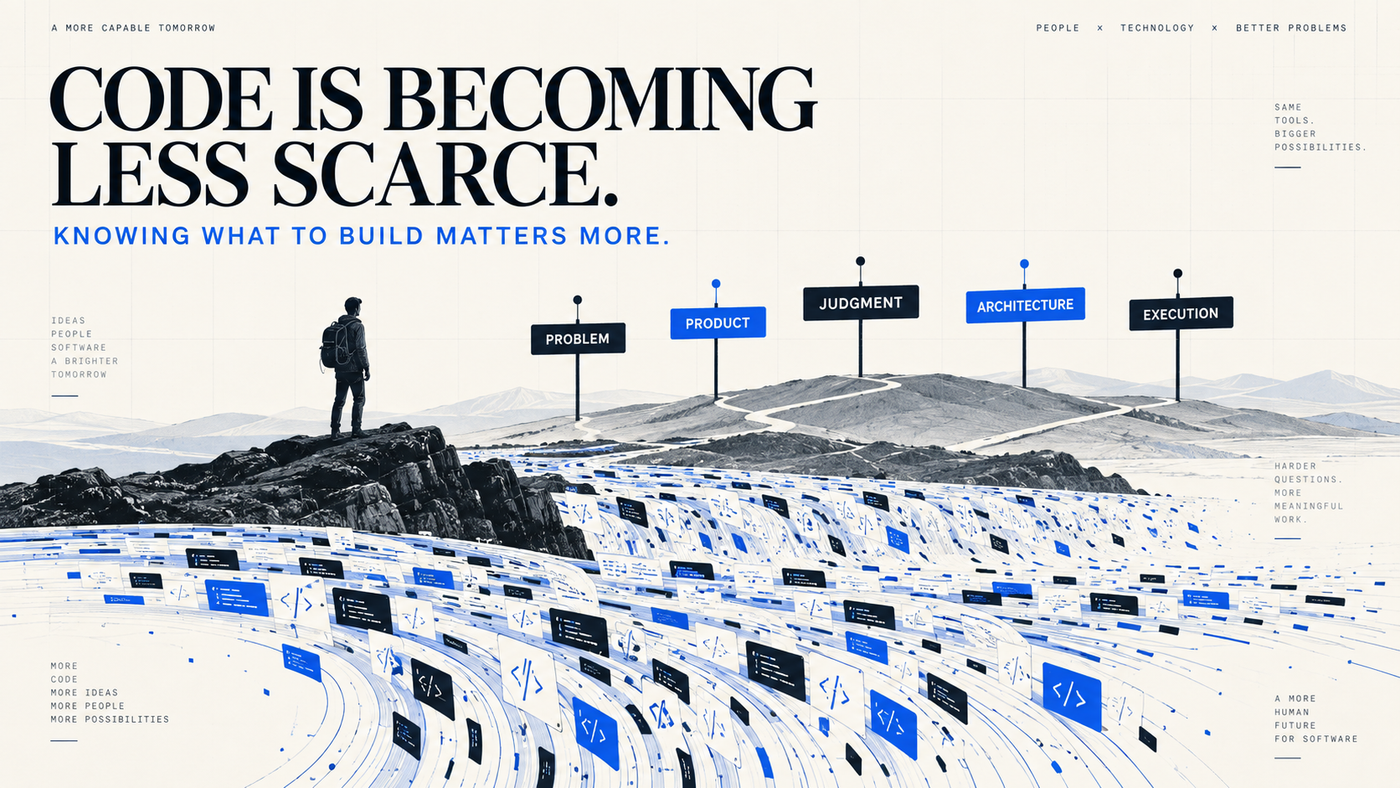
Code is becoming less scarce
Maybe this is the simplest way to think about where software engineering is heading.
Code is becoming less scarce.
AI can generate it faster.
Developers can prototype faster.
Teams can experiment faster.
And the distance between an idea and a working piece of software keeps shrinking.
So the things around the code start to matter more.
Can you identify a real problem?
Can you understand the user?
Can you make good trade-offs?
Can you design something that will survive beyond the demo?
Can you tell when AI-generated code is good enough and when it needs to be rewritten?
Can you ship something that creates actual value?
Those are much harder problems.
And maybe that's a good thing.
Because if AI takes away some of the repetitive work of software development, developers get more room to focus on the parts that require curiosity, judgment and responsibility.
The question isn't really whether AI can write code.
We already know it can.
The more interesting question is:
When everyone can build faster, who will know what is actually worth building?